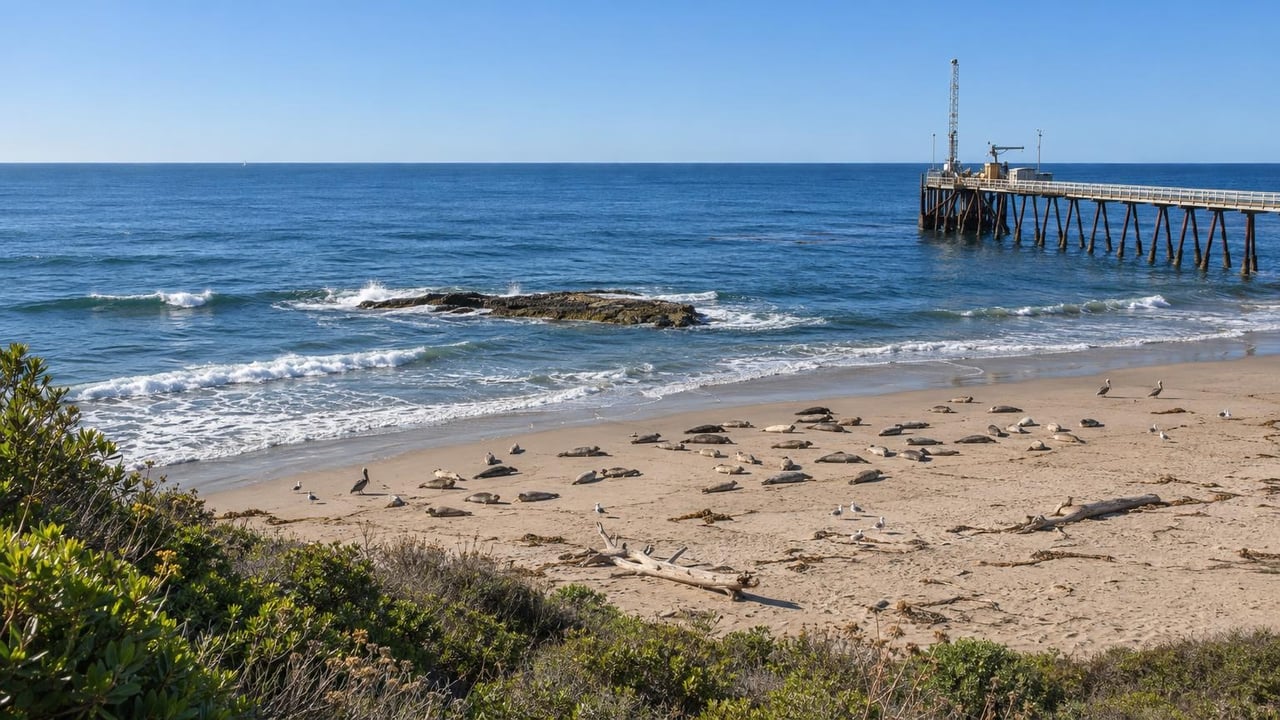
On Tuesday morning, the beach around Casitas Pier closes for the harbor seals' pupping season, as the City of Carpinteria does every year from December 1 through May 31. The bluff above it stays open. From the overlook on the Coastal Vista Trail you can see the whole rookery, and for the next six months that is where the watching happens.
The Santa Barbara Independent describes this 1,500 feet of beach as one of the last two harbor seal breeding and pupping grounds left on the Southern California mainland. For anyone in Carpinteria, it's a short walk from home. The main thing to know for this season is that the number of seals on the sand on a given morning depends heavily on whether anyone has walked onto it.
The overlook is the front row
The overlook sits inside the Carpinteria Bluffs Nature Preserve. The city lists the preserve as the home of the Lois Sidenberg Coastal Overlook and part of the Coastal Vista Trail. The city's own suggestion for a visit is a quiet one, with dogs on leash and the watching done from the bluff-top trail. From up there, December is when the season people come for begins, with mothers and newborn pups on the sand below.
A colony counted from the bluff for decades
People have been counting these seals for years, and the numbers give the closure its context. The Independent reported that volunteers counted 365 seals in 2004 and that most days now see fewer than 100. In its December 2025 report, Noozhawk cited figures from the city's advisory committee. The 2015 season had 396 adults and more than 80 pups, and the 2021 season had 220 adults and 64 pups. One Seal Watch volunteer told the Independent that over her 18 years of Monday morning shifts, she has seen the colony shrink from about 400 seals to about 100.
The city formed its Harbor Seal Advisory Committee in fall 2021 to look into that decline. Susan Mailheau, a veterinarian, and Randall Moon both sit on the committee and are members of Save Our Seals. Speaking to the Independent in April, Mailheau said this season produced "half the pups we normally have." In 2024 the committee recommended closing the beach for three full years to see whether the colony would grow. Both the city and the California Coastal Commission declined, and the committee is still pursuing approval for a three-year trial. The seasonal closure that starts Tuesday is the usual annual one, separate from that proposal.
The colony's history explains why returning matters so much. According to the Independent, harbor seals live 25 to 30 years and return to the beach where they were born. They also use that beach year-round to regulate body temperature, digest food, sleep, and get ready for dives. A seal born below the bluff will probably come back to it for decades.
Why the morning count swings so much
Save Our Seals is a committee of the Carpinteria Valley Association, and it publishes monthly recaps in Coastal View News. In one week of its August recap, the count ranged from a high of 85 seals to a low of zero. In the following week it ranged from 104 to 39. The group writes that counts vary a lot over a day and a week, and that low counts, including days with no seals at all, are "usually due to disturbances by people."
Seal Watch volunteers watch the beach most closely at low tide, when beachgoers and dogs can reach the seals most easily. When a walker cuts across the sand, the seals leave the beach for the water, and the count from the overlook drops with them. In that same Independent story, a volunteer described people who ignored requests to stop and kept walking across the beach. In practice, the easiest thing a resident can do for the colony this winter is stay on the bluff, keep the dog on the trail, and tell visiting friends why.
Getting to the overlook
The city suggests parking at 499 Linden Avenue. From that lot, the trail to the overlook is about 1.3 miles. It's fairly flat but unpaved and uneven, so wear shoes that can handle a muddy December morning. For a shorter walk, the city's parks and open space page also lists parking at the Bluffs Nature Preserve off Bailard Avenue and at Viola Fields. The Land Trust for Santa Barbara County directs drivers to US-101 Exit 85 at Bailard and keeps the Bluffs open every day from sunup to sundown.
Save Our Seals names early morning as the best time to watch, which works well with a coffee from Linden Avenue before or after. Volunteers covered the overlook from 7 a.m. until sunset last season, according to KCLU. The station put the volunteer roster at 117, and on the January day it visited, a volunteer counted 57 seals on the beach.
Joining the people with the binoculars
According to the Independent, Seal Watch volunteers record how many seals they see and how many people visit the overlook, hand out pamphlets, and respond to trespassers. Save Our Seals provides training and takes volunteer inquiries through savecarpseals.com, which also lists on-site training by arrangement. The volunteer who described the colony's decline to the Independent has worked a two-hour Monday shift for nearly two decades. That gives a sense of the commitment, and of how much one regular shift adds to a long record of counts.
The open land behind the overlook
Turn around at the overlook and you face the other big Carpinteria story of 2026. The undeveloped parcel at 5885 Carpinteria Avenue, commonly called the Tee Time site, is where a housing project named The Farm Carpinteria has been proposed. On its project page, the city lists 191 homes, made up of 94 townhomes and 97 detached homes, with 39 of them deed-restricted affordable units. The applicant is Central Coast CA Ventures, LLC, applying on behalf of the property owner, Carp Bluff, LLC. The city deemed the formal application complete on December 30, 2025.
Residents have followed the project closely. Coastal View News reported a packed room and strong opposition at the April 9 open house. It also reported on residents who saw room for more discussion or changes to the plan. Citizens for the Carpinteria Bluffs and the Carpinteria Valley Association hired the Environmental Defense Center to take part in the review. Among the issues they raised were beach access and buffers around the rookery. The environmental review began with a scoping meeting at City Hall on June 30.
On Nov. 18, the city announced that the developer had proposed an alternative. It would build 175 homes at Tee Time instead of 191 and add 87 deed-restricted affordable rental units, plus a manager's unit, at the S&S Seeds site at 6155-6175 Carpinteria Avenue. The alternative also includes improved ocean views from the Bluffs Nature Preserve, new public parking for the preserve, dedicated open space on both sites, and a new location for the Carp Children's Farm School, with existing trails kept in place. At its Nov. 23 meeting, the City Council considered whether to sign an agreement to study that alternative alongside the original plan in the environmental review. The city said that meeting would not approve either version. The city takes public comments at [email protected].
Andrea O'Loughlin keeps a close eye on the Bluffs and the rest of the Carpinteria coast. If you'd like to talk through what the Tee Time review could mean for your street or your plans, schedule a 15-minute consultation with Searching Santa Barbara.